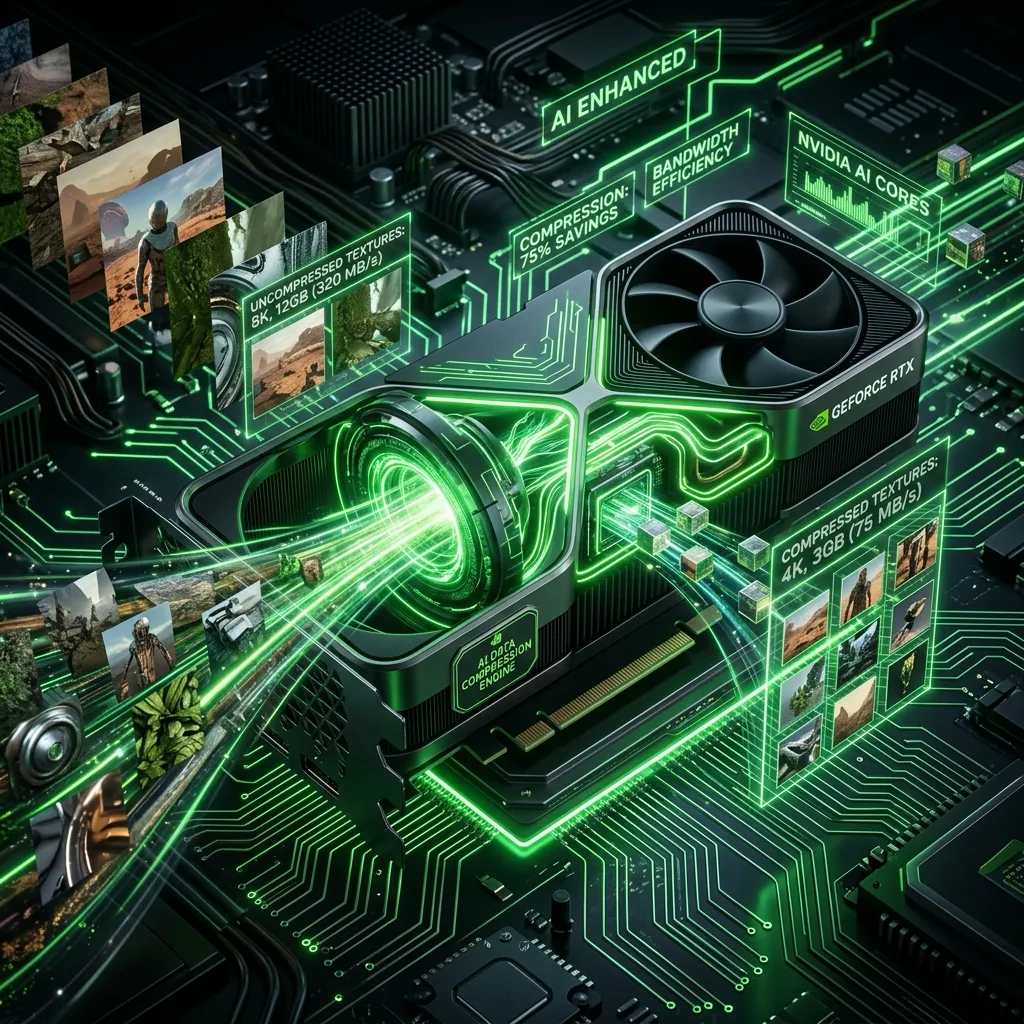
If there is one hardware spec that has consistently kept PC gamers and developers awake at night over the last few years, it’s Video RAM (VRAM). As game studios push for increasingly photorealistic worlds, the demand for massive, high-resolution textures has skyrocketed, often causing even mid-to-high-tier graphics cards to stutter under the weight of “texture bloat.”
But the era of VRAM anxiety might finally be drawing to a close. NVIDIA has introduced a groundbreaking solution that moves away from traditional brute-force storage: Neural Texture Compression (NTC). By leveraging the power of artificial intelligence, NVIDIA is fundamentally changing how our GPUs handle high-fidelity game assets.
The Problem: Uncompressed Ambition
For decades, the industry standard for texture compression has relied on block-based formats like BCn. While effective, they have a strict lower limit on how small a texture can be compressed without introducing ugly artifacts. In modern AAA titles, the sheer volume of 4K and 8K textures needed to dress a scene can easily eclipse 12GB to 16GB of VRAM requirements.
When a GPU runs out of VRAM, it has to swap data with much slower system memory, resulting in massive frame drops, stuttering, and agonizingly slow asset loading (the dreaded “texture pop-in”). For developers, the choice was binary: either compromise on visual fidelity to hit memory targets or lock out players who couldn’t afford top-tier GPUs.
Enter Neural Texture Compression
NVIDIA’s Neural Texture Compression throws out the traditional rulebook. Instead of storing every single pixel (texel) of a texture directly in your GPU’s memory, NTC compresses the texture data into a set of highly compact, learned latent features.
Here is where the magic happens: at runtime, a small, specialized neural network reconstructs the texel values on demand. The GPU calculates exactly what the texture should look like at the moment it needs to draw it on your screen, rather than pulling a pre-baked, massive file from VRAM.
Because this AI decompression process is handled seamlessly by the Matrix Acceleration hardware on modern NVIDIA graphics cards (specifically, the Tensor Cores), it imposes practically zero performance penalty on the main rendering pipeline.
85% Less VRAM, Same Photorealism
The efficiency gains of NTC are nothing short of monumental. In technical demonstrations—such as the “Tuscan Villa” scene showcased at GTC—NVIDIA proved that a heavily detailed environment that typically requires 6.5 GB of VRAM with traditional BCn compression could be rendered using a mere 970 MB with NTC.
That is an astonishing 85% reduction in memory footprint, with virtually no discernible loss in image quality.
This massive saving presents developers with a golden opportunity. They can choose to:
- Dramatically lower the hardware barrier to entry, ensuring games run flawlessly on budget GPUs with less memory.
- Double down on detail, utilizing the saved VRAM space to pack in exponentially more complex materials and even higher-resolution textures within the same physical memory budget.
Beyond the GPU
The benefits of Neural Texture Compression extend far beyond the inside of your PC case. Because the textures themselves are stored as incredibly tiny AI representations, the total install size of games could shrink dramatically. This means fundamentally shorter download times, smaller patch sizes, and less pressure on your precious SSD storage.
Furthermore, as Microsoft introduces “Cooperative Vectors” within DirectX to standardize the use of AI hardware for tasks exactly like this, we are looking at a future where neural rendering isn’t just a niche NVIDIA party trick, but a unified industry standard.
The Future is Latent
NVIDIA’s Neural Texture Compression is a perfect example of how AI is evolving beyond generative chat models and diving deep into the plumbing of computer graphics. By teaching our GPUs to “imagine” textures rather than just storing them, NVIDIA isn’t just saving VRAM; they are tearing down the memory walls that have bottlenecked graphical advancement for years.
The next generation of photorealistic gaming won’t just require bigger, bulkier graphics cards—it will be built on smarter, more elegant AI compression. And our SSDs, GPUs, and wallets will thank them for it.