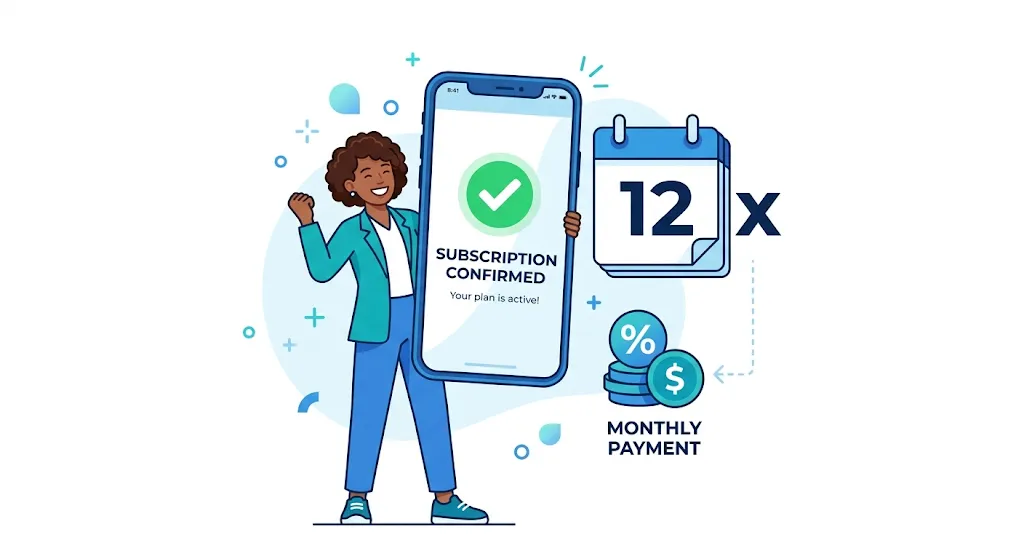
For years, the App Store has presented a binary choice: pay a premium for month-to-month flexibility or pay a large lump sum upfront for an annual discount. On April 27, 2026, Apple officially introduced a “middle path” that could reshape the subscription economy: monthly subscriptions with a 12-month commitment.
This new billing model allows developers to offer the discounted rates typically reserved for annual plans but split those costs into twelve manageable monthly installments. Here is everything you need to know about this shift.
How the 12-Month Commitment Works
Under this new structure, a user agrees to a year-long contract but pays on a monthly basis. This mirrors the “annual, paid monthly” models popularized by services like Adobe Creative Cloud.
- The Commitment: Unlike a standard monthly plan, where a user can walk away at any time, this option legally binds the user to twelve consecutive payments.
- Cancellation Rules: Users can “cancel” their subscription at any point, but this does not stop the payments immediately. Instead, it prevents the subscription from renewing after the 12-month term is complete. The user remains “on the hook” for the remaining payments of the current term [1.1, 1.7].
- Transparency: To avoid “dark patterns,” Apple has integrated a tracking system within the Apple Account settings. Users can view exactly how many payments they have completed and how many remain in their commitment period [1.6, 1.15].
Why It Matters for Users: Affordability vs. Lock-in
The primary benefit for users is affordability. Many high-value professional or creative apps carry annual price tags that can be a barrier to entry. By breaking a $100/year plan into roughly $8.33/month installments, Apple is lowering the “sticker shock” for premium software [1.12, 1.14].
However, critics warn of subscription fatigue and the risks of deeper lock-in. While the monthly cost is lower, the loss of “anytime” cancellation flexibility means users must be more certain of their long-term need for an app before hitting the subscribe button [1.8, 1.16].
Why It Matters for Developers: Retention and Revenue
For developers, this move is a powerful tool for reducing churn.
- Steadier Cash Flow: It provides the revenue predictability of an annual plan without the friction of a large upfront payment that often scares off potential subscribers [1.4].
- Increased Conversion: Historically, monthly billing converts better than annual billing. Draping an annual discount in a monthly payment structure is expected to boost “pro” tier sign-ups [1.7].
- Developer Tools: The feature is already live for testing in Xcode and App Store Connect, allowing developers to configure these plans ahead of the public rollout [1.1, 1.2].
Availability and Limitations
Despite the global nature of the App Store, there are two major exceptions to this launch: the United States and Singapore.
Apple has not officially stated why these regions are excluded, though industry analysts suggest it may be due to ongoing regulatory scrutiny or specific billing disclosure requirements in those markets [1.2, 1.11].
Technical Requirements:
- System Version: Requires iOS 26.4, iPadOS 26.4, macOS Tahoe 26.4, or later.
- Official Rollout: The feature will go live for users alongside the release of iOS 26.5 and its counterparts in May 2026 [1.3, 1.6].
The Bottom Line
Apple’s new commitment model is a clear signal that the company is borrowing from the “SaaS playbook” to stabilize its Services revenue. By making long-term subscriptions feel like small monthly wins, they are helping developers secure more loyal customers while giving users a more budget-friendly way to access high-end tools—provided they are willing to sign on the dotted line for a full year.
Sources & Citations
- [1.1] 9to5Mac: “Apple introduces monthly subscriptions with a 12-month commitment on the App Store.”
- [1.2] MacRumors: “Apple Introduces App Store Monthly Subscriptions With 12-Month Commitment.”
- [1.4] Gulf News: “Apple’s new App Store subscription model could change how users pay for apps.”
- [1.6] Apple Developer: “Now Available: Monthly Subscriptions with a 12-Month Commitment.”
- [1.7] PhoneArena: “Apple just gave developers a new way to lock you into longer iPhone subscriptions.”
- [1.11] PCMag: “iPhone Apps May Soon Let You Subscribe for a Year, But Pay Monthly.”
- [1.12] AppleInsider: “App Store annual subscriptions get new discounted monthly option.”
- [1.15] Forbes: “Apple Changes iPhone App Store After 18 Years For Better-Value Deals.”