It’s hard to believe, but the tech giant that redefined our modern relationship with personal computing, communication, and digital lifestyle has officially hit the half-century mark. April 1, 2026, marks exactly 50 years since Steve Jobs, Steve Wozniak, and Ronald Wayne founded Apple Computer in a modest Los Altos garage. Today, from the ring-shaped corridors of Apple Park, Tim Cook’s latest “50 Years” letter to the community signals that while the past was revolutionary, the next 50 years will be truly extraordinary.
The global celebrations in March set the stage in spectacular fashion. When Alicia Keys sat at a grand piano in the middle of Grand Central Terminal, her kickoff performance wasn’t just a concert—it was a statement. With spatial audio bouncing perfectly off the cavernous terminal walls and augmented reality elements painting the air for those wearing Vision devices, Apple reminded us that they don’t just build hardware; they orchestrate experiences. As the “50 Years of Thinking Different” campaign plastered across billboards in New York, London, and Tokyo, the world collectively paused to reflect on the staggering journey of the bitten apple.
From the Garage to the Spaceship
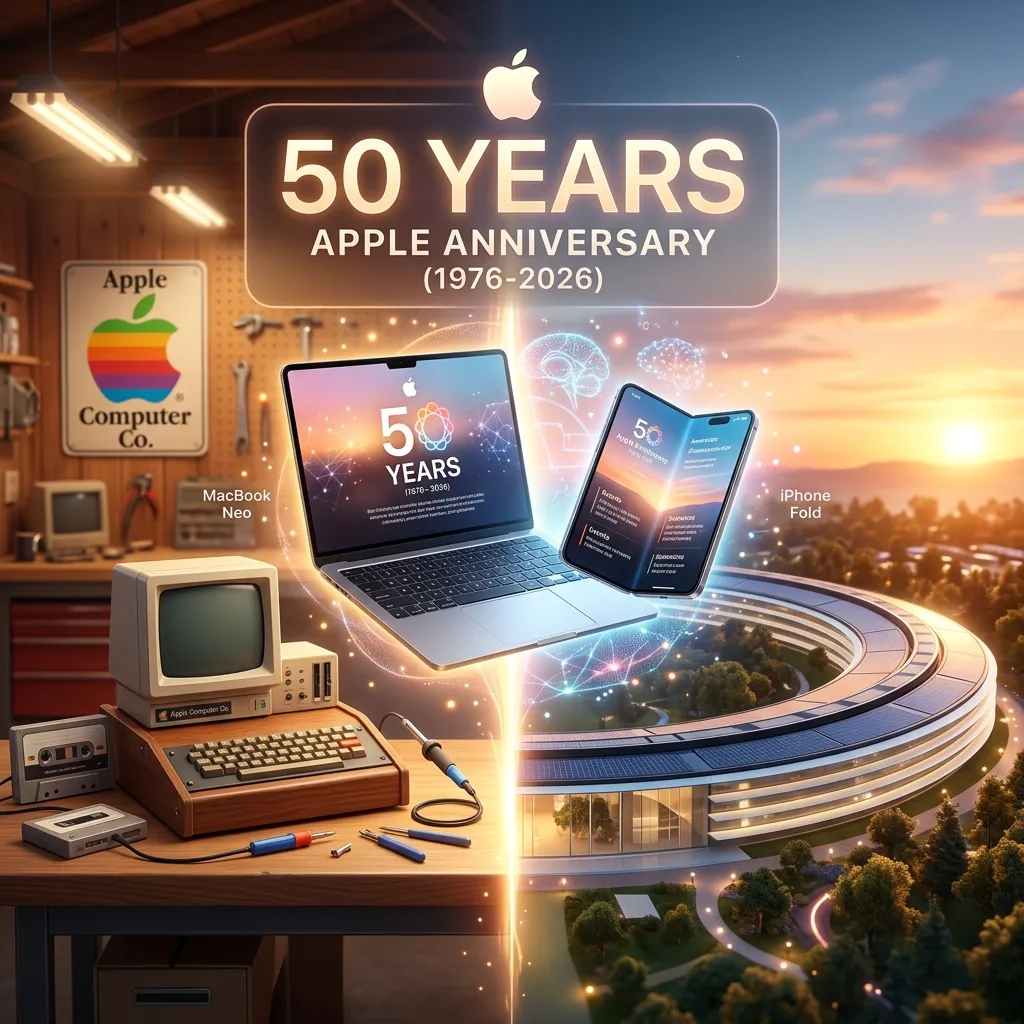
To appreciate where Apple is going, we must briefly look at where they came from. The narrative of Apple is often summarized by its iconic spaces. It began in the cluttered, low-tech environment of Jobs’ childhood home garage—a symbol of raw, unpolished innovation. Fast forward 50 years, and the company operates out of Apple Park, a multi-billion dollar architectural marvel that looks like it landed from the future.
Apple Park isn’t just an office; it’s the physical manifestation of Apple’s design ethos: seamless, environmentally conscious, and painstakingly detailed. It represents the maturation of a scrappy startup into the most influential corporation on the planet. The transition from the wooden boards of the Apple I to the monolithic curved glass of their Cupertino headquarters perfectly tracks their impact on human culture.
The Legacy of the “Big Three”
For the last couple of decades, Apple’s success has been fiercely driven by what we can safely call the “Big Three”: the Mac, the iPhone, and the iPad.
The Mac democratized the graphical user interface. It went from the beige box of 1984 to the razor-thin, custom-silicon powerhouses we use today, permanently altering the landscape of creative professionals and everyday users alike.
The iPhone, introduced in 2007, fundamentally changed human behavior. It wasn’t just a phone; it was an internet communicator, a high-end camera, and a tether to the sum of human knowledge, perfectly slipping into our pockets. It birthed the app economy and killed off a dozen single-use gadgets in one sweeping blow.
The iPad filled the gap we didn’t know existed between the phone and the laptop, becoming the definitive tablet experience and transforming how we consume media, sketch, and learn.
These three pillars built a trillion-dollar empire. But as Tim Cook hinted in his recent public letter, resting on the laurels of the Big Three isn’t in Apple’s DNA. The golden age of the screen is evolving into something vastly more immersive.
The New Era: Spatial Computing and Apple Intelligence
If the last 50 years were about putting a computer on every desk and in every pocket, the next 50 are about blending computing seamlessly into our environment. Apple is shedding the confines of traditional glass rectangles.
Leading this charge is Spatial Computing. Since the launch of the Vision Pro, Apple has iteratively refined its approach to augmented and virtual realities. The bulky headsets of yesteryear are slowly giving way to lighter, more integrated wearables. The March global celebrations, teeming with AR-enhanced moments, proved that Apple views the world itself as an endless canvas.
Paired with this hardware shift is the explosive rise of Apple Intelligence. While competitors raced to build chatbots, Apple took a typically deliberate approach, deeply embedding generative AI and machine learning into the very fabric of their operating systems. Apple Intelligence isn’t a feature you open; it’s a silent partner anticipating your needs, dramatically reducing the friction of daily digital life while aggressively guarding user privacy.
Looking Ahead: The 2026 Product Cycle
The 50th-anniversary year isn’t just about nostalgia; it’s about arguably the most aggressive product cycle we’ve seen in a decade.
First on the horizon is the highly anticipated MacBook Neo. Rumored to feature a completely bezel-less, edge-to-edge dynamic display with an ultra-tactile solid-state haptic keyboard, the Neo is expected to be the biggest redesign to the laptop form factor since the introduction of the MacBook Air. It represents the absolute pinnacle of Apple Silicon, blending impossible battery life with desktop-crushing performance.
But perhaps most thrillingly, the long-whispered iPhone Fold is finally moving from rumor to reality. While competitors rushed to market with early, fragile foldables, Apple waited. The upcoming device is expected to feature a self-healing crease-less display and a completely reimagined interface that bridges the gap between an iPhone Pro and an iPad mini. It’s a bold flex for the half-century mark—proving Apple still has the power to define a product category years after others attempted to pioneer it.
iOS 27 and a Supercharged Siri
Hardware is nothing without software, and the impending unveiling of iOS 27 at WWDC promises to be a watershed moment. The centerpiece is a vastly supercharged Siri. Moving past the rudimentary voice assistant we’ve known, the new iteration is reportedly an omnipresent, proactive, natively intelligent agent. Capable of understanding complex, multi-layered commands and maintaining deep contextual awareness across all your Apple devices, this supercharged Siri is Apple’s definitive answer in the AI arms race.
50 Years of Thinking Different
From a garage in 1976 to the global epicenter of technology in 2026, Apple’s journey is the definitive modern business epic. They have weathered near-bankruptcy, the tragic loss of a visionary founder, and the relentless pressure of global expectations. Yet, as the “50 Years of Thinking Different” campaign illuminates, their core philosophy remains remarkably unchanged.
They still exist at the intersection of technology and the liberal arts. They still believe that people with passion can change the world for the better. As we look toward the MacBook Neo, the iPhone Fold, and an AI-driven future, one thing is certain: the world is still watching, and Apple is still thinking different. Here’s to the next 50 years.